NABH Accredited Ayurveda Hospital


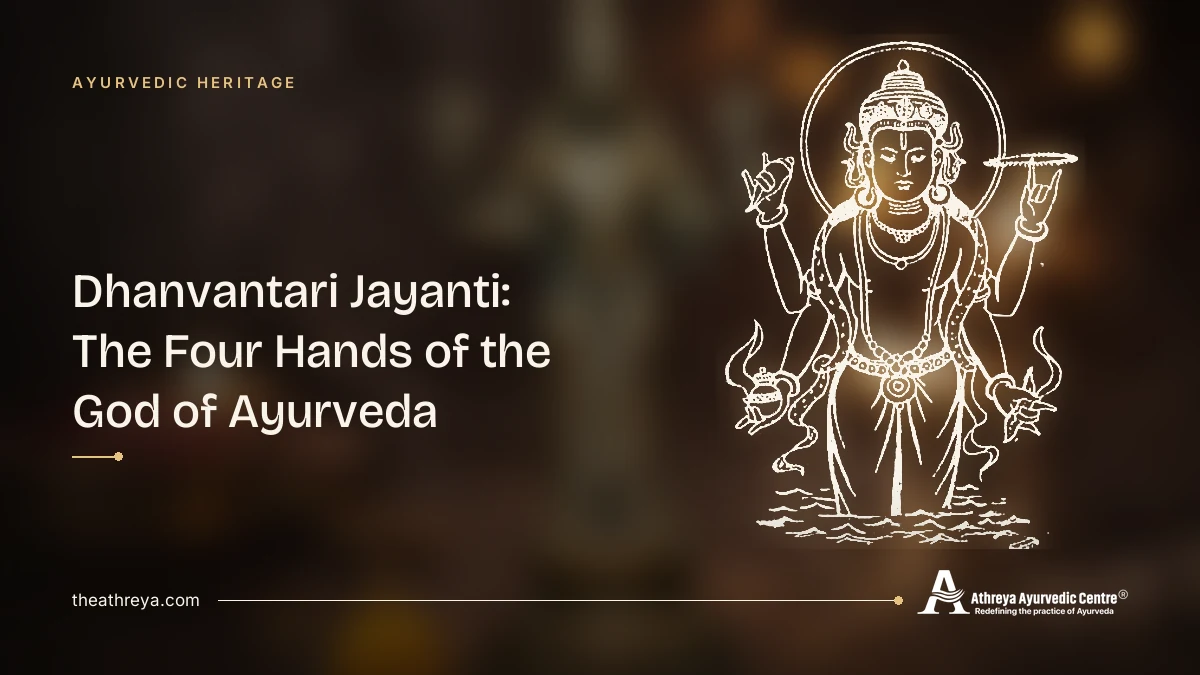
Every year on Dhanteras, the thirteenth day of the dark fortnight of Kartika, physicians of Ayurveda across India light a lamp for Dhanvantari. In our family, that lamp has been lit by six generations of physicians. Today I want to explain who he is, and why the four things he holds still guide how we treat our guests at Athreya.
Who is Dhanvantari?
Dhanvantari is honoured as the god of Ayurveda and the physician of the gods. According to the Puranas, when the gods and asuras churned the ocean of milk (Samudra Manthan), many treasures rose from the water. The last to appear was Dhanvantari, carrying a pot of Amrita, the nectar of immortality.
He is regarded as a form of Lord Vishnu. Classical texts also link him to the teaching of Ayurveda itself: the Sushruta Samhita, one of the founding texts of Ayurvedic surgery, presents its teaching as given by Divodasa Dhanvantari, the king of Kashi, to Sushruta and his fellow students.
That is why Dhanvantari Jayanti, his birthday, is a sacred day for every Ayurvedic physician. In Keralam you can feel this in his temples, such as the Dhanvantari temples at Thottuva and Nelluvai, where people come to pray for health.
What do Dhanvantari’s four hands hold?
Dhanvantari is usually shown with four hands. Images differ from region to region, but the four objects most often seen are the conch, the chakra, the pot of nectar and the leech. Each one carries a lesson about healing.
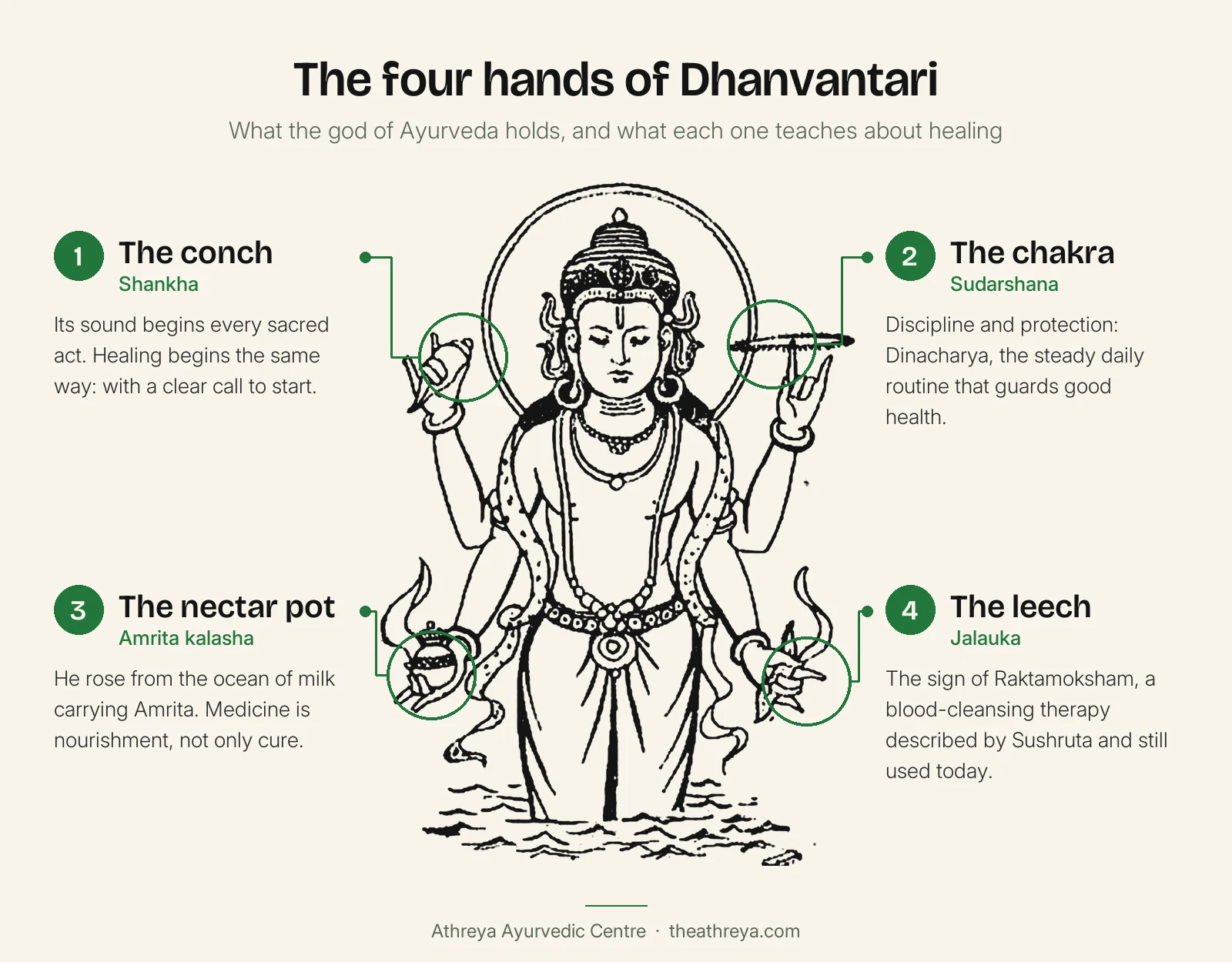
1. The conch (Shankha): healing begins with a clear call
The sound of the conch opens every sacred act. In healing, the first step is just as important: recognising that something needs care, and deciding to begin. Many of our guests tell us that the hardest part of their journey was not the treatment, but the decision to start it.
2. The chakra (Sudarshana): discipline protects health
The wheel stands for order, rhythm and protection. In Ayurveda this is Dinacharya, the daily routine: waking with the sun, eating at regular times, sleeping on time. These small habits protect health far more than any single treatment can. When you leave Athreya, the routine you learned here is the medicine you take home.
3. The pot of nectar (Amrita kalasha): medicine as nourishment
Dhanvantari did not rise from the ocean holding a weapon. He rose holding nectar. Ayurveda sees medicine the same way: food, herbs and medicated oils that nourish the body back to balance, not only things that fight disease. This is why the kitchen matters as much as the treatment room, and why every meal at Athreya follows the Ayurvedic treatment protocol.
4. The leech (Jalauka): an ancient therapy still used today
The leech surprises many people. It is the sign of Raktamoksham, the Ayurvedic therapy of cleansing the blood, one of the classical Panchakarma procedures. The Sushruta Samhita describes the use of leeches (Jalaukavacharana) in detail, including how to choose them and when to use them. More than two thousand years later, Ayurveda still uses this gentle form of blood-letting for selected skin and circulatory conditions, always under a physician’s care.
How we keep this tradition at Athreya
For six generations, our family has practised Ayurveda as a living tradition, passed from parent to child. The four hands of Dhanvantari describe the shape of every stay with us:
- A clear beginning: a consultation with the doctor before anything else.
- A steady routine: yoga, meals and treatments at set times each day.
- Nourishment: Ayurvedic food and medicines prepared for your constitution.
- Classical therapies: Panchakarma, the five cleansing procedures, given by trained therapists (Paricharaka) under a physician’s supervision.
If you would like to know whether an Ayurvedic stay is right for you, browse our guest FAQ or write to us for a consultation.
Happy Dhanvantari Jayanti. May this day bring you good health, the truest wealth.
Frequently asked questions
When is Dhanvantari Jayanti?
It falls on Dhanteras, the thirteenth day (Trayodashi) of the dark fortnight of Kartika, two days before Diwali. In 2026 it falls on Friday, 6 November.
Is National Ayurveda Day the same as Dhanvantari Jayanti?
From 2016 to 2024, India marked National Ayurveda Day on Dhanvantari Jayanti. Since 2025 it has a fixed date, 23 September, because the lunar date of Dhanteras changes every year.
Why does Dhanvantari hold a leech?
The leech (Jalauka) represents Raktamoksham, the Ayurvedic therapy of cleansing the blood. It shows that Ayurveda includes precise medical procedures, not only herbs and diet.
Why do Ayurvedic doctors pray to Dhanvantari?
He is honoured as the first physician and the source of Ayurvedic knowledge. Many physicians pray to him before treating a patient, asking that their hands bring healing.