
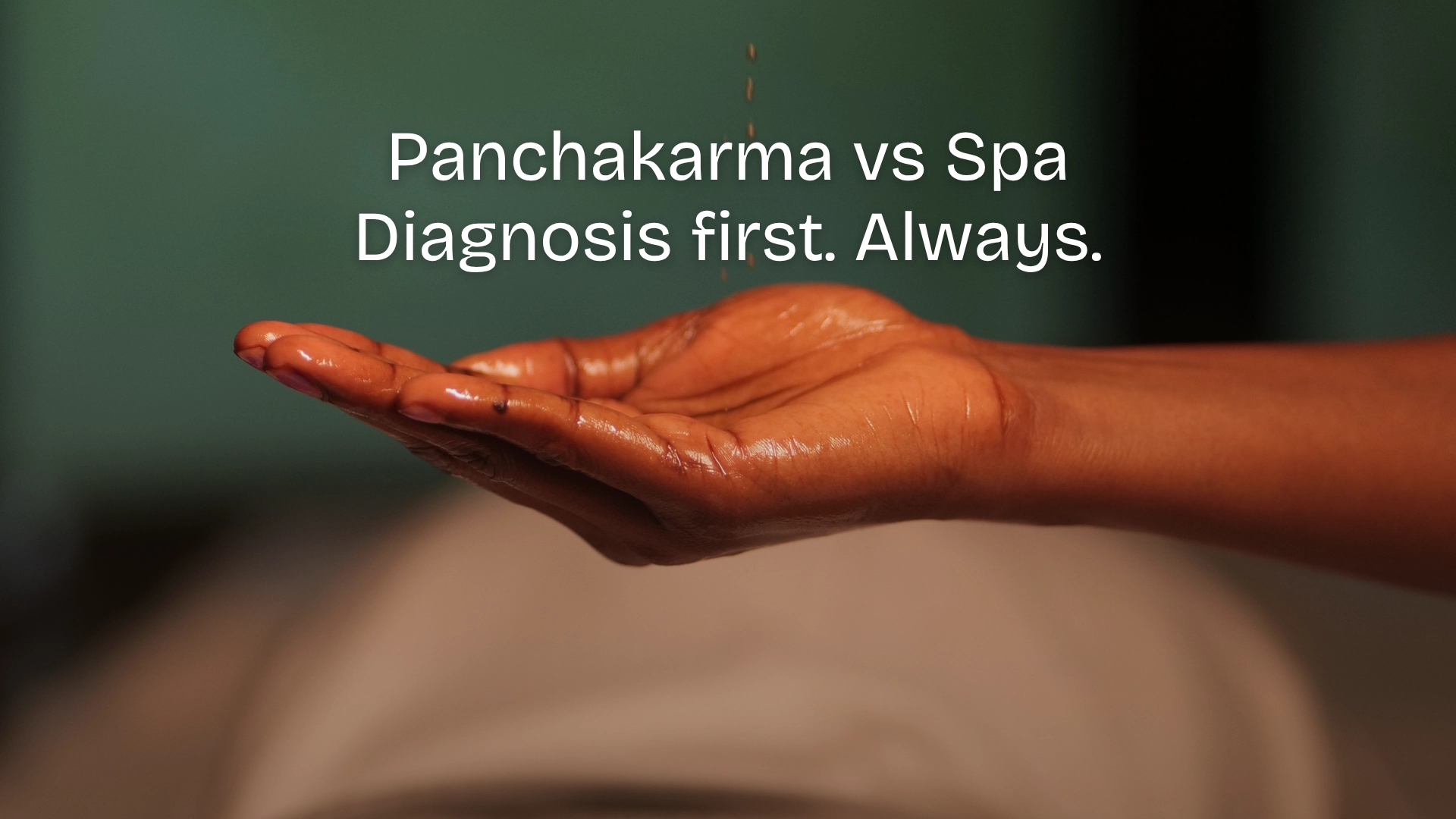
Panchakarma is not a spa treatment. It is a physician-prescribed medical process, built on a diagnosis, delivered in phases, and monitored daily for how your body actually responds. A spa treatment, however relaxing, is a fixed package delivered the same way to everyone who books it. The confusion between the two is one of the most common — and most costly — mistakes people make when they set out to try Ayurveda.
At Athreya, we see the consequences of that confusion often: guests who arrive having already tried “Panchakarma” somewhere else, only to describe a week of oil massages and steam baths with no medical form filled, no diagnosis made, no customised therapy plan, and no lasting medical impact. That isn’t a failure of Ayurveda. It’s a failure of the word being used loosely and irresponsibly.
Why the Confusion Happens
Panchakarma and spa therapy share some surface-level features — oil, warmth, touch, a calm setting — because oil massage (Abhyanga) and herbal steam (Swedana) are genuinely part of Panchakarma. But in classical Ayurvedic clinical practice, these are preparatory therapies. They exist to prepare the body for what comes next. A spa stops there. Panchakarma is only just beginning.
This is where the wellness industry has, understandably, taken a shortcut. Preparatory therapies are pleasant, low-risk, and easy to deliver at scale — which is exactly why so many resorts and day spas package them as “Panchakarma” without ever performing the actual purification procedures the term refers to.
What Spa Therapy Actually Is
Spa therapy is designed around comfort and relaxation. It typically includes:
- A menu of treatments you select yourself, rather than a physician prescribing what you need
- Standardised sessions of a fixed length, regardless of your health history or condition
- No diagnostic assessment beforehand and no clinical monitoring during or after
- Therapists trained in massage and bodywork, not physicians trained in medical diagnosis
There is real value in this. Spa therapy can genuinely reduce stress and improve short-term wellbeing. What it cannot do is diagnose an underlying imbalance, address the root cause of ill health, or guide your body through a structured recovery. It was never designed to.
What Panchakarma Actually Is
Panchakarma is a complete clinical process with four distinct phases, each of which changes depending on the person receiving it:
- Ayurvedic diagnosis — A physician assesses your health history, digestive strength, dosha imbalance, and the root cause of your symptoms before any treatment plan exists.
- Poorva karma (preparation) — External oleation (Abhyanga, oil massage), Swedana, and internal oleation prepare the body to safely release toxins. This is the phase that looks most like a spa treatment, and the one most often mistaken for the whole therapy. Note: not every patient is ready for oil massage. Many first need Dhanyamladhara therapy before they move on to oil-based treatments.
- Pradhana karma (core purification) — The actual classical procedures: Vamana, Virechana, Vasti, Nasya, or Raktamokshana, chosen based on your specific diagnosis. Not every guest receives every procedure — your physician selects only what is clinically appropriate for you.
- Paschat karma (restoration) — A carefully managed rebuilding phase where digestion, strength, and immunity are restored through diet and herbal medicine, so the benefits are sustained rather than lost within weeks or a few months. (See our after-Panchakarma diet and lifestyle guide.)
No spa performs phases one, three, or four. That is not a criticism of spas — it is simply outside their scope of service, their training, and their purpose.
Five Real Differences That Matter
1. Diagnosis first, or no diagnosis at all
Panchakarma begins with a physician’s assessment. Spa treatment begins with a price list.
2. Individualised, or standardised
Your Panchakarma plan is designed for your body’s health needs, your doshic imbalance, and your condition, and is adjusted daily based on how you respond. A spa package is the same for every guest who books it.
3. Physician-led, or therapist-led
Panchakarma procedures are prescribed and supervised by a qualified Ayurvedic physician. Spa treatments are delivered by trained therapists, which is appropriate for relaxation but not for medical decision-making.
4. Duration reflects the process, not a marketing package
A genuine Panchakarma programme takes a minimum of 14 days, because the body needs that time to prepare, purify, and rebuild. A 3-, 5-, or 7-day “Panchakarma” is, at best, the preparatory phase alone — pleasant, but not the therapy itself.
5. Real contraindications exist
Panchakarma is not suitable during pregnancy, acute fever or infection, extreme physical weakness, or immediately after surgery — which is exactly why a physician assessment has to come first. Spa therapy carries no such medical gatekeeping, because it isn’t making the same kind of physiological change.
Why This Distinction Matters for Your Health
If what you actually need is rest and relaxation, a good spa will give you that honestly, and there is nothing wrong with choosing one. But if you are dealing with a chronic condition — digestive problems, hormonal imbalances, chronic fatigue, pain in multiple joints, spine problems, or stress that hasn’t resolved with rest alone — a spa package will not address the underlying imbalance, no matter how many days you spend there. You may leave relaxed. You are unlikely to leave changed.
This is also a safety question, not just an outcomes question. The core Panchakarma procedures are powerful interventions. Administered without a proper diagnosis or physician supervision, they can do more harm than good. This is precisely why the classical texts of Ayurveda insist on physician oversight and monitoring at every stage — and why that requirement isn’t a formality at a genuine Ayurvedic medical centre. It’s the entire safeguard.
How Athreya Approaches This Honestly
At Athreya, every Panchakarma programme begins with a full diagnostic consultation with our physicians, Dr. S.P. Sreejit, MD (Ayu), and Dr. Jayalakshmi G., continuing a family practice of classical Ayurveda that now spans six generations and 180 years. Your plan is reviewed daily and adjusted based on how your body actually responds — not delivered as a fixed package.
The herbal medicines used during treatment are prepared by our sister concern, Athreya Pharmaceuticals, a GMP-certified manufacturer — for the same reason a genuine pharmacy matters more than a spa’s product shelf: what goes into your body during a real cleansing process should be traceable, not generic.
We are NABH-accredited and have been trusted by health seekers from 124 countries. But we would rather you understood the actual difference between Panchakarma and spa therapy than simply take our word for which one we offer.
If a 3-day “Panchakarma” is what fits your schedule, we’ll tell you honestly that it’s a preparatory experience, not the full clinical process — and help you plan for the real thing when you’re ready. (If you’re still deciding, read Is Panchakarma Worth It? An Honest Answer.)
The One Question to Ask Before You Book Anywhere
Before booking “Panchakarma” at any centre, ask one simple question: will a physician assess me first, and will the treatment change based on that assessment? If the answer is no, what you’re booking is a spa experience with a borrowed name. There is nothing wrong with that — as long as you know which one you are investing your time, money and faith in.
At Athreya, that assessment starts before you arrive. Fill in our medical questionnaire for a free online consultation with our doctors.
This article reflects Athreya’s classical Ayurvedic practice and is intended for general information. Panchakarma is a medical process and should only be undertaken following a physician’s assessment. If you have a chronic health condition, are pregnant, or are currently under medical treatment, please consult your doctor before beginning any detox programme.