
If you have been told you have PCOS — you have probably also been told one of the following:
Lose weight. Take Metformin. Consider the pill. Come back when you want to conceive.
And you have probably felt, somewhere beneath the clinical language, that none of these answers address what is actually happening in your body.
You are right.
What Modern Medicine Says About PCOS
Polycystic Ovary Syndrome affects approximately one in five Indian women. It is one of the most common hormonal conditions in the world — and one of the most poorly understood.
Modern medicine classifies PCOS by its symptoms — irregular periods, elevated androgens, polycystic ovaries on ultrasound. Treatment is largely symptomatic — hormonal contraceptives to regulate the cycle, Metformin to manage insulin resistance, fertility treatments when conception is the goal.
These interventions manage the condition. They do not resolve it.
When a woman stops taking the pill after years of PCOS management — her symptoms return. Often worse than before. Because the pill did not treat PCOS. It suppressed its expression.
This is not a criticism of modern medicine. It is an honest observation about the limits of treating a complex systemic condition symptomatically.
What Ayurveda Sees — And Has Always Seen
Ayurveda does not have a condition called PCOS. It predates the diagnostic category by several thousand years.
But it has always understood the conditions that produce what we now call PCOS — and it has always had a framework for treating them.
In classical Ayurvedic terms, PCOS is understood primarily as an imbalance of three interconnected systems:
Agni — digestive fire. When Agni is impaired, food is not properly metabolised. Partially digested material — called Ama — accumulates in the channels of the body, disrupting normal physiological function including hormonal signalling.
Medovaha Srotas — the metabolic channel. The fat tissue and its associated channels are intimately connected to reproductive function in Ayurveda. When this channel is congested — as it is in the insulin resistance and metabolic dysfunction that characterises PCOS — the reproductive system is directly affected.
Artava — the female reproductive tissue. Classical Ayurveda describes Artava as the seventh and finest tissue in the body — the reproductive essence. Its proper formation depends on the health of every tissue that precedes it in the metabolic sequence. When digestion is impaired, when metabolism is disrupted, Artava cannot form properly.
This framework — digestion, metabolism, reproductive tissue — describes with remarkable precision what modern endocrinology is only beginning to fully understand about PCOS: that it is not primarily a gynaecological condition, but a metabolic one.
The Ayurvedic Treatment Approach for PCOS
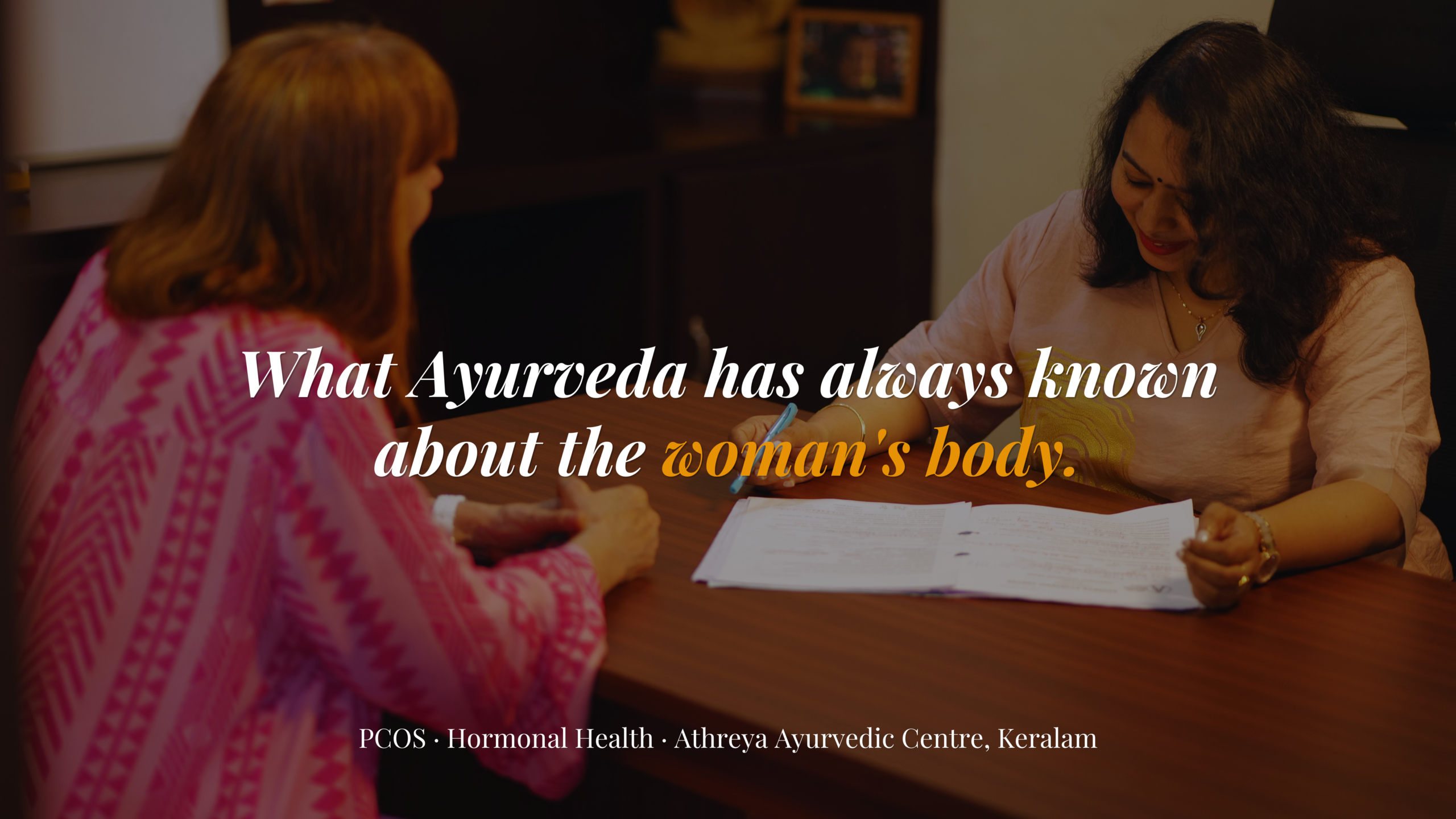
At Athreya Ayurvedic Centre, women’s health has been a clinical speciality for generations. Dr. Jayalakshmi G. — the sixth generation of our founding doctor family — has treated hundreds of women with PCOS over the course of her career.
Her approach is classical — and it is comprehensive.
Phase 1 — Shodhana (Purification)
The first priority is removing Ama — the accumulated toxins that are disrupting metabolic and hormonal function. This is achieved through classical Panchakarma — specifically the Virechana (therapeutic purgation) and Basti (medicated enema) stages, which are the most effective classical procedures for clearing the metabolic channels.
This phase typically takes 14 to 21 days of residential treatment at Athreya.
Phase 2 — Shamana (Pacification)
Once the channels are clear, specific Ayurvedic herbal medicines are prescribed to pacify the underlying imbalances — regulate Vata, restore metabolic function, and support the healthy formation of reproductive tissue.
These medicines are individually prescribed — not standardised herbal supplements. The formulation depends on the woman’s specific constitution, the nature of her PCOS presentation, and her health history.
Phase 3 — Rasayana (Rejuvenation)
The final phase involves deep nourishment of the reproductive tissue — building Artava from its foundation. Specific Rasayana formulations are used alongside dietary guidance and lifestyle practices that support long-term hormonal health.
This phase continues after the woman returns home — with follow-up consultations and medicine protocols maintained for 3 to 6 months.
What Results Look Like
Ayurveda does not promise what it cannot deliver. Dr. Jayalakshmi is honest about outcomes — because honesty is the foundation of genuine medical practice.
What clinical experience at Athreya shows:
Most women with PCOS see significant improvement in cycle regularity within 3 to 6 months of the complete treatment protocol — residential Panchakarma followed by the home programme.
Metabolic markers improve. Insulin sensitivity, weight, and inflammatory markers typically show measurable improvement after 21-day Panchakarma. These improvements are not cosmetic — they reflect genuine metabolic correction.
Androgen levels reduce. Hair fall, acne, and excess facial hair — the visible symptoms of elevated androgens — typically improve over 3 to 6 months as the underlying imbalance is addressed.
Fertility outcomes. Athreya has extensive clinical experience supporting women who wish to conceive. Dr. Jayalakshmi is careful and honest about what Ayurveda can offer — and equally honest about when conventional fertility treatment may be a better first step.
The women who achieve the deepest results are those who commit to the complete protocol — residential treatment followed by the home programme — and who are patient. Ayurveda does not work in the timeframe of a pharmaceutical. It works in the timeframe of the body.
The One Thing Most PCOS Treatments Miss
Dr. Jayalakshmi observes the same pattern in nearly every woman with PCOS who comes to Athreya:
She has been managing her condition for years. She has been told what to take. She has not been told why.
Ayurveda begins with why.
Why is your Agni impaired? What in your diet, your stress load, your sleep patterns, your daily rhythms — has disrupted the metabolic fire that should be converting food into nourishment and reproductive health?
The treatment follows from the answer to that question. Not from the diagnosis.
This is the fundamental difference between treating PCOS symptomatically and treating the woman who has PCOS.
Is Ayurvedic PCOS Treatment Right for You?
Ayurvedic treatment for PCOS at Athreya is particularly suited for women who:
- Have been diagnosed with PCOS and are not finding lasting relief through conventional management
- Are experiencing irregular cycles, hair fall, acne, weight gain, or fertility challenges
- Want to understand the root cause of their condition — not just manage its symptoms
- Are willing to commit to a minimum 21-day residential programme followed by a home protocol
- Are looking for a natural approach to hormonal health that works with the body rather than suppressing it
The first step is a conversation with Dr. Jayalakshmi — who will review your medical history, your reports, and give you an honest assessment of what Ayurveda can offer for your specific situation.
Begin Your Consultation
Dr. Jayalakshmi G. offers a free online consultation for women seeking Ayurvedic support for PCOS and hormonal health.
The process is simple — submit your medical questionnaire and our team will guide you through each step.
Begin your free consultation with Dr. Jayalakshmi →
Or WhatsApp us at +91 70347 12345
Read about Dr. Jayalakshmi and Athreya’s six-generation healing heritage →
Read what our guests say about their experience at Athreya →
Athreya Ayurvedic Centre · Pakkil P.O., Pallom, Kottayam, Kerala 686012 NABH Accredited · 6 Generation Doctor Family · Guests from over 120 Countries www.theathreya.com