

Ayurveda is a complete system of medicine from India that treats each person as an individual, not as a diagnosis.
That is the short answer. The longer one is what this guide is for.
I grew up in a family where Ayurveda was not a subject. It was simply how we lived. My family has practised it for six generations, across 180 years, starting with palm-leaf manuscripts we still keep at home. Today I am an Ayurvedic physician and Director of Athreya Ayurvedic Centre in Pallom, Kottayam.
Every week, guests from around the world ask me the same first question: “What is Ayurveda, really?” Many have read a dozen articles and come away more confused. Some think it is a massage. Some think it is a diet. Some think it is a set of herbal supplements.
It is none of those on its own. So here is the plain-English explanation I give in my consultation room, without the jargon and without the hype.
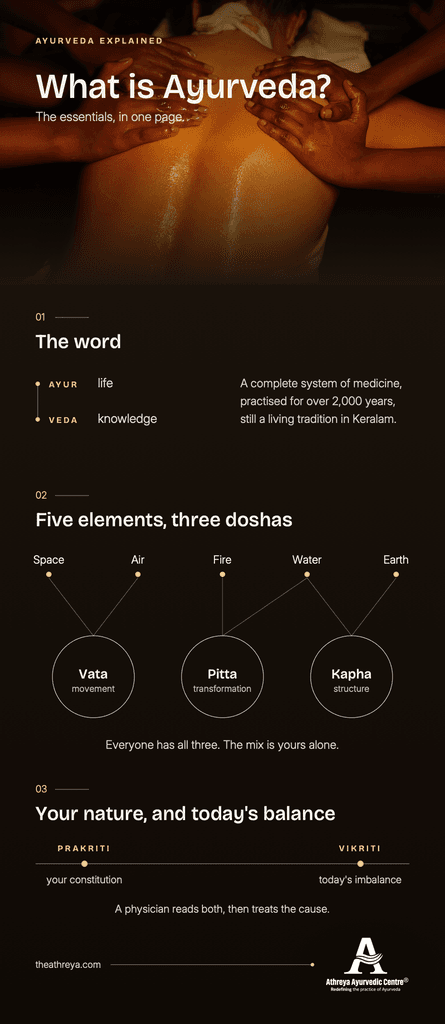
Ayurveda meaning: “the knowledge of life”
The word Ayurveda joins two Sanskrit words. Ayus means life. Veda means knowledge. Put together, Ayurveda means “the knowledge of life”.
Notice that it does not say “the knowledge of disease”. That difference shapes everything that follows.
A working definition of Ayurveda
The classical texts define Ayurveda as the knowledge of what supports life and what harms it, and of what makes a life happy or unhappy. In plainer terms:
DefinitionAyurveda is a traditional system of medicine that aims to keep healthy people healthy, and to restore balance in people who are unwell, by understanding each person’s unique constitution.
Those two aims come straight from the texts. The first is protecting the health of the healthy. The second is relieving the illness of the sick. Most modern healthcare focuses on the second. Ayurveda gives equal weight to the first.
What “healthy” means in Ayurveda
One classical description of a healthy person goes beyond the absence of symptoms. A person is healthy when:
- the body’s three functional forces (the doshas) are in balance
- digestion and metabolism work well
- the body’s tissues are nourished and its wastes are cleared properly
- the mind, the senses and the inner self are clear and content
That last point matters. In Ayurveda, you are not fully well if your blood tests are normal but you cannot sleep, cannot think clearly or feel constantly on edge.
Where Ayurveda comes from
Ayurveda developed in India over many centuries. Its core knowledge was gathered into classical texts compiled roughly two thousand years ago, drawing on far older oral traditions.
Three texts are studied most closely to this day:
- Charaka Samhita, the foundational text on internal medicine
- Sushruta Samhita, known for its detailed account of surgery
- Ashtanga Hridayam, a later summary that became the backbone of Ayurveda in Keralam
Keralam holds a special place in this story. Its humid climate, rich plant life and long line of physician families kept classical practice alive here when it faded elsewhere. Treatments now associated with Kerala Ayurveda, such as Panchakarma and the oil-based therapies, were refined by these families over generations.
My own family’s story began in a village called Vagasheri. A wandering teacher, a Lada Guru, stayed with our ancestors and left them palm-leaf manuscripts on the uses of medicines. Each generation since has carried that knowledge forward, from medicines made by hand at home, to a family pharmacy founded in 1921, to Athreya Ayurvedic Centre, founded in 1996 by my parents, Dr. B. Girish and Dr. J. Padmadevi, the fifth generation. You can read the full story on our Legacy Tree page.
Today Ayurveda is a recognised and regulated system of medicine in India. Physicians train for a five-and-a-half-year degree (BAMS), and many go on to a postgraduate MD in Ayurveda.
The core idea: you are part of nature
Ayurveda starts from a simple observation. The same forces that shape the natural world also shape the human body.
It describes everything, including you, as a combination of five elements, the Pancha Mahabhuta:
- Space (Akasha): openness, the room in which things happen
- Air (Vayu): movement
- Fire (Agni or Tejas): heat and transformation
- Water (Jala): fluidity and cohesion
- Earth (Prithvi): structure and solidity
These are not chemical elements. Think of them as qualities. Bone is mostly earth. Blood and lymph are mostly water. Digestion is fire. The movement of breath and nerve signals is air.
From this comes the most important idea in Ayurveda: no two people are made in exactly the same proportions. Two guests can arrive with the same complaint, say chronic joint pain, and receive quite different treatment because their bodies are built differently. This is why we say Ayurveda is personalised, not packaged.
The three doshas: Vata, Pitta and Kapha
The five elements combine into three working forces in the body, called the doshas. If the elements are the raw materials, the doshas are how those materials behave inside you.
Everyone has all three. What differs is the proportion.
| Dosha | Elements | Qualities | What it governs | Signs when out of balance |
|---|---|---|---|---|
| Vata | Space + Air | Dry, light, cold, mobile | Movement: breath, circulation, nerve signals, elimination | Anxiety, poor sleep, dry skin, constipation, joint stiffness |
| Pitta | Fire + Water | Hot, sharp, intense | Transformation: digestion, metabolism, body temperature, sharpness of mind | Acidity, inflammation, skin rashes, irritability |
| Kapha | Water + Earth | Heavy, slow, steady, smooth | Structure and stability: tissues, lubrication of joints, strength, calm | Sluggishness, weight gain, congestion, low motivation |
Vata: the force of movement
Vata moves everything: your breath, your heartbeat, your thoughts. People with a lot of Vata tend to be quick, creative and lively. When Vata rises too far, that liveliness tips into restlessness, worry and broken sleep. Cold weather, irregular meals and constant travel all aggravate it.
Pitta: the force of transformation
Pitta turns food into energy and information into understanding. Pitta-dominant people are often focused, driven and sharp. In excess, the same fire shows up as heartburn, inflammation, short temper or burnout from pushing too hard.
Kapha: the force of structure
Kapha holds you together. It gives the body its strength and the mind its steadiness. Kapha-dominant people tend to be calm, loyal and resilient. Too much Kapha brings heaviness: slow digestion, weight gain, congestion and a hard time getting started in the morning.
Prakriti and Vikriti: who you are, and where you are now
Two terms make sense of all this.
- Prakriti is your constitution: the dosha balance you were born with. It stays largely the same through life.
- Vikriti is your current state: how your doshas have shifted because of diet, stress, season, age or illness.
Treatment is not about changing who you are. It is about bringing your present state back towards your natural balance.
A word of caution on online “dosha quizzes”. They can be a fun starting point, but they often confuse your constitution with your current imbalance. An experienced physician separates the two by examining you, not only by asking questions.
Agni: why Ayurveda asks so much about your digestion
If you consult an Ayurvedic physician, be ready for many questions about your appetite, your bowels and how you feel after meals. This surprises some guests. It is central to the system.
Ayurveda calls the body’s digestive and metabolic power Agni, meaning fire. Strong, steady Agni turns food into nourishment for every tissue. Weak or erratic Agni leaves food partly digested.
That undigested residue is called Ama. Think of it as metabolic sludge. Ayurveda sees the build-up of Ama as a root of many chronic problems, from heaviness and fatigue to joint pain and skin complaints.
So before treating the symptom, a physician asks a simpler question: is this person digesting well? Much of Ayurvedic treatment, including diet, medicines and cleansing therapies, aims first to restore Agni and clear Ama.
How an Ayurvedic physician assesses you
An Ayurvedic diagnosis looks at the whole person, not just the complaint that brought them in.
The classical method is an eight-fold examination, the Ashtavidha Pariksha. It covers the pulse (Nadi), urine, stool, tongue, voice, touch and skin, eyes, and overall build and appearance. Alongside it, the physician asks about your sleep, appetite, emotions, work, daily routine and the seasons when you feel better or worse.
Pulse reading is the part people find most intriguing. In skilled hands it gives a real picture of how the doshas are behaving. But it is one tool among several, not a party trick.
In our practice, we also read your existing medical reports, scans and prescriptions. Ayurveda does not ask you to ignore modern diagnostics. A blood test and a pulse reading tell different parts of the same story, and a good physician uses both.
At Athreya, this process begins before you travel. Guests complete a medical questionnaire and can speak with a physician in an online consultation. If we do not think Ayurveda is the right approach for your condition, we tell you plainly at this stage.
How Ayurveda treats
Ayurvedic treatment works on several levels at once. Most programmes combine some or all of the following.
1. Diet (Ahara)
Food is treated as medicine. What you eat, when you eat and how it is cooked are adjusted to your constitution and your digestion. A Pitta imbalance and a Kapha imbalance call for very different plates.
2. Daily and seasonal routine (Dinacharya and Ritucharya)
Regular sleep, regular meals and habits suited to the season do quiet but steady work. Many chronic problems ease once the daily rhythm is right.
3. Medicines (Aushadha)
Ayurvedic medicines are prepared from herbs, minerals and other natural ingredients according to classical formulas. They are prescribed by a physician for your specific case. At Athreya, they are prepared by our sister concern, Athreya Pharmaceuticals, a GMP-certified manufacturer.
4. Therapies
These include treatments many people have heard of, such as Abhyanga (full-body medicated oil therapy) and Shirodhara (a steady flow of medicated oil or liquid over the forehead). They are chosen as medicine, not as relaxation.
5. Cleansing: Panchakarma
For deeper or long-standing imbalances, Ayurveda uses Panchakarma, the classical “five actions” for clearing accumulated doshas and Ama from the body. These are Vamana (therapeutic emesis), Virechana (medicated purgation), Vasti (medicated enema), Nasya (nasal medication) and Raktamokshana (bloodletting). Not every guest needs all five. The physician selects what suits you.
Panchakarma follows three stages: preparation (Purvakarma, with internal and external oiling and herbal steam), the main cleansing procedures, and recovery (with careful diet, rejuvenating therapies and guidance for home). Learn more on our Panchakarma page.
6. Rejuvenation: Rasayana
After cleansing comes rebuilding. Rasayana therapies aim to strengthen the tissues, support immunity and slow the wear of age.
Why it takes time
Guests often ask why we recommend stays of 14, 21 or even 28 days. The answer is that each stage needs its proper time, and the body needs rest between them. Rushing a cleanse is not a shortcut. It can leave you weaker than before. Fourteen days is the minimum for a complete Panchakarma programme. Some things cannot be accelerated. Healing is one of them.
What Ayurveda is not
Because Ayurveda has become popular, it is often sold as something it is not. Here is where I draw the line.
- It is not a spa treatment. A massage with scented oil in a hotel is pleasant. It is not Ayurvedic medicine unless a physician has assessed you and chosen the therapy and the oil for your condition. (See Panchakarma vs Spa Therapy.)
- It is not a quick fix. A three-day “Panchakarma” cannot do what a properly staged programme does. Be wary of anyone who promises fast results.
- It is not a replacement for emergency or acute care. For a heart attack, a serious infection or a broken bone, you need a hospital. Ayurveda is often valuable alongside conventional treatment, under physician supervision, and in long-term recovery.
- “Natural” does not mean “harmless”. Ayurvedic medicines are real medicines. They should be prescribed by a qualified physician and made by a reliable manufacturer. Please do not self-medicate from the internet.
- It is not a promise of a cure. No honest physician, in any system of medicine, can guarantee an outcome. What we can promise is a careful assessment, an honest opinion and treatment designed around you.
If you are taking medication from your doctor, keep taking it. Tell your Ayurvedic physician everything you take, and never stop a prescribed medicine without talking to the doctor who prescribed it.
Where to begin
You do not need to travel to India to start living a little more in line with Ayurveda. A few simple habits are safe for almost everyone:
- Wake and sleep at roughly the same time each day.
- Eat at regular times, and make your midday meal the largest, when digestion is strongest.
- Favour warm, freshly cooked food over cold or reheated meals.
- Eat when you are hungry, and stop before you feel heavy.
- Notice how you feel after meals. Your digestion is giving you information.
These habits support everyone, whatever their dosha. For anything beyond them, such as specific herbs, cleansing or treatment for a health condition, speak to a qualified physician first.
If you are considering a stay in Keralam, the best first step is a conversation. Tell us about your health, your history and what you hope for. We will tell you honestly whether we can help, and how long a programme would suit you.
Frequently asked questions about Ayurveda
What is Ayurveda in simple words?
Ayurveda is India’s traditional system of medicine. Its name means “the knowledge of life”. It aims to keep healthy people well and to restore balance in people who are unwell, by treating each person according to their individual constitution.
What are the three doshas?
The three doshas are Vata, Pitta and Kapha. They are the functional forces that govern movement (Vata), transformation and metabolism (Pitta), and structure and stability (Kapha). Everyone has all three, in a unique proportion.
How do I find out my dosha?
The most reliable way is an assessment by a qualified Ayurvedic physician, who examines your pulse, tongue, build and history. Online quizzes can be a starting point, but they often mix up your natural constitution with a temporary imbalance.
Is Ayurveda scientific?
Ayurveda is a recognised and regulated system of medicine in India, with degree-level training for physicians. Research on Ayurvedic treatments is growing, and the strength of evidence varies from condition to condition. At Athreya, we combine classical Ayurvedic assessment with modern medical reports.
Is Ayurveda safe?
Ayurveda is safe when it is practised by a qualified physician, using medicines from a reliable, quality-certified manufacturer. The risks come from self-prescribing, untested products and untrained practitioners.
Can I use Ayurveda alongside my current medication?
In many cases, yes, but only under physician supervision. Share a full list of everything you take with your Ayurvedic physician, and do not stop any prescribed medicine without speaking to the doctor who prescribed it.
What is the difference between Ayurveda and an Ayurvedic spa?
Ayurveda is a medical system: treatment follows a physician’s diagnosis and is reviewed as it progresses. A spa offers relaxation treatments that may borrow Ayurvedic names and oils, usually without a medical assessment.
How long does Ayurvedic treatment take?
It depends on the person and the condition. Lifestyle changes can help within weeks. A complete Panchakarma programme needs a minimum of 14 days, and we often recommend 21 or 28 days for long-standing conditions.
Begin with a conversation
Have a question about your own health? Tell our physicians your history and what you hope for. We will tell you honestly whether we can help.
Practical questions? See our Guest FAQ.This article is for general education and is not a substitute for personal medical advice. Please consult a qualified physician before starting any treatment.