NABH Accredited Ayurveda Hospital


“Tourist visa or medical visa?” is one of the questions guests ask us most often once they have chosen their dates. India now has a visa made for exactly this journey: the Ayush visa, created for people who travel to India for Ayurveda and other traditional treatment. If your stay is mainly for treatment, it is the visa we recommend, and we provide the visa invitation letter you need for it. For a short programme combined with a holiday, the e-Tourist visa can also work. This guide helps you choose.
Visa rules change. Always confirm the current rules on the official Indian e-Visa website or with your Indian embassy or consulate before you apply. This guide explains how the options work and what we send you.
What is an Ayush visa?
AYUSH stands for Ayurveda, Yoga & Naturopathy, Unani, Siddha, Sowa-Rigpa and Homoeopathy, the traditional systems of medicine recognised by India’s Ministry of Ayush. In 2025 the Government of India gave these treatments their own visa category, so that foreign guests coming for traditional treatment no longer had to fit into a general medical or tourist visa.
There are two forms:
- e-Ayush visa: applied for online, as part of the e-Medical visa, with a letter from the treating hospital in India.
- Ayush visa (AY-1): a regular visa from the Indian embassy or consulate in your country. It is meant for longer treatment and can be granted for up to a year.
Family members or a companion travelling with you can apply for an Ayush Attendant visa (e-Ayush Attendant online, or AY-2 at the embassy). Up to two attendants are allowed per patient.
When should you take an Ayush visa?
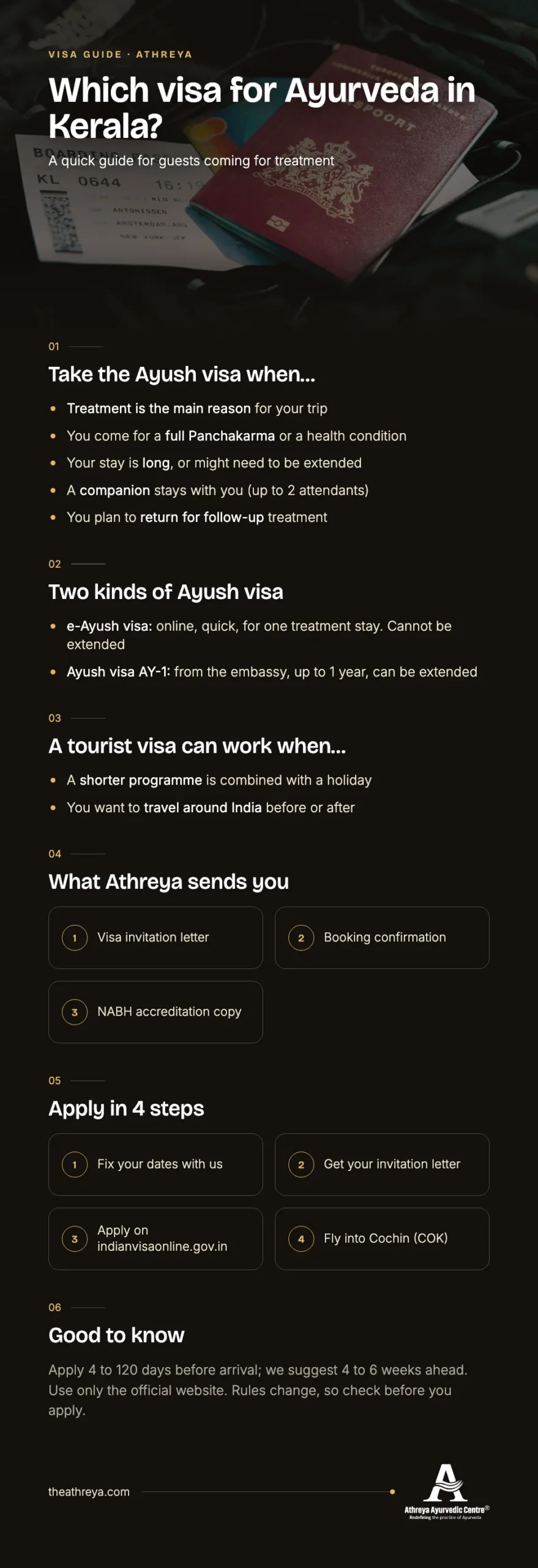
Take an Ayush visa when treatment is the main reason for your journey. In particular:
- You are coming for a full Panchakarma or a treatment programme, not a holiday with a few massages. The Ayush visa states your purpose clearly, so there is no doubt at immigration about why you are in India.
- You have a health condition you want treated, such as joint or spine problems, digestive disorders, skin conditions, stress or sleep problems, and you are bringing medical reports for our doctors.
- Your stay is long: several weeks, a 28-day or longer programme, Kutee Praveshika Rasayana, or more than one course of treatment within a year.
- You may need more time. Ayurveda sometimes shows during treatment that a longer course would help. The regular Ayush visa (AY-1) from the embassy can be issued for up to a year and extended in India; an e-Tourist visa cannot.
- A family member or friend is coming to stay with you. Up to two companions can travel on an Ayush Attendant visa that is linked to yours.
- You would like to return for follow-up treatment. The regular Ayush visa allows more than one entry, so a second course later in the year is simple.
- Your embassy, employer or insurer asks for a treatment visa.
Which form to choose:
- e-Ayush visa (online): quick to get and right for a single treatment stay. Like all Indian e-Visas, it cannot be extended once you are here.
- Ayush visa AY-1 (embassy): the best choice for long or repeated treatment, because it can be issued for up to a year and extended.
Can I come for Ayurveda treatment on a tourist visa?
Yes, India’s e-Tourist visa lists “medical treatment including treatment under Indian systems of medicine” among its permitted purposes, and Ayurveda is one of those systems. It can suit a guest who is combining a shorter programme with travel around India, because a tourist visa is not tied to treatment.
If treatment is your main purpose, though, the Ayush visa is the visa made for you, and we are glad to provide the invitation letter for it.
Ayush visa vs medical visa vs tourist visa
| e-Tourist visa | e-Ayush visa | Ayush visa (AY-1) | |
|---|---|---|---|
| How to apply | Online | Online (under e-Medical) | Indian embassy / consulate |
| Ayurveda treatment allowed | Yes | Yes, its purpose | Yes, its purpose |
| Invitation letter from Athreya | Not required (a booking confirmation helps) | Yes | Yes |
| Travel around India | Yes | Linked to treatment | Linked to treatment |
| Companion | Applies for their own tourist visa | Up to 2 e-Ayush Attendant visas | Up to 2 AY-2 visas |
| Extendable in India | No | No | Yes, yearly |
The e-Medical visa is meant for treatment in modern medicine hospitals. For Ayurveda, choose e-Tourist or e-Ayush.
What we send you for your visa
Once your stay is confirmed, we send you:
- A booking confirmation with your name, dates and our full address. This is useful for any visa, including the e-Tourist visa.
- A visa invitation letter for an e-Ayush or Ayush visa. It states your name, passport number, the planned treatment and its estimated length.
- A copy of our NABH accreditation, the national standard that makes Athreya eligible to host Ayush visa patients.
Please ask for your invitation letter once your dates are fixed. The details on the letter must match your passport exactly.
How to apply for an e-Ayush visa, step by step
- Confirm your dates with us and ask for your Ayush visa invitation letter.
- Apply on the official website, indianvisaonline.gov.in, choosing e-Medical visa with the Ayush purpose. Use only the official site; many look-alike sites charge extra fees.
- Upload your passport photo page, a photograph and our invitation letter.
- Apply at least 4 days and at most 120 days before you arrive. We suggest 4 to 6 weeks ahead, to leave time for questions.
- Fly into Cochin (COK) or Thiruvananthapuram (TRV). Both accept e-Visas, and Cochin is the closer of the two to Athreya in Kottayam.
Once your visa is ready, read Planning Your Stay and How to Prepare for Panchakarma Before You Arrive in Kerala. For other questions about your stay, see Before You Book.
Frequently asked questions about the Ayush visa
Do I need an Ayush visa for Panchakarma in Kerala?
If Panchakarma is the main reason for your trip, the Ayush visa is the right visa: it was created for exactly this. It is especially worth it for longer programmes, if you may need to extend, or if a companion is coming with you. A guest combining a short programme with a holiday can also use the e-Tourist visa, which allows treatment under Indian systems of medicine.
When should I take an Ayush visa instead of a tourist visa?
When treatment is your main purpose, when your stay is long or might become longer, when you travel with a companion who will stay with you, or when you plan to come back for follow-up treatment within the year.
Can I travel around India on an Ayush visa?
An Ayush visa is issued for treatment. If you want to travel widely before or after your programme, the e-Tourist visa is usually the better fit. Check the current rules for your visa type.
Can my partner come with me?
Yes. On an Ayush visa, up to two family members or companions can apply as attendants. On a tourist visa, your partner simply applies for their own e-Tourist visa.
Can I extend my e-Ayush visa in India?
No. Indian e-Visas cannot be extended or converted. If you might need a longer stay, apply for the regular Ayush visa (AY-1) at the embassy before you travel.
How long does it take?
e-Visas are usually decided within a few working days, but apply at least 4 days before arrival (we recommend several weeks). Embassy visas take longer; check with your embassy.
Do you help with the visa application?
Yes. We send your visa invitation letter and booking confirmation, and we are happy to answer questions. We cannot apply on your behalf; the application is made by you on the official website.
Visa rules change and differ by nationality. Information checked November 2026 against the official Indian e-Visa website and Indian embassy guidance. Please confirm the current rules before you apply.